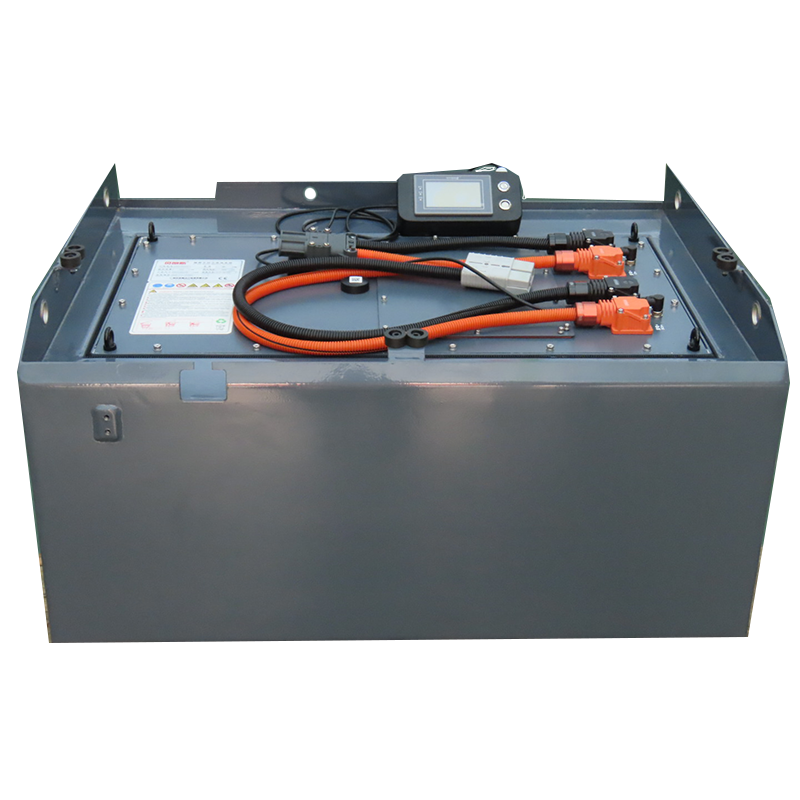
Why is lithium iron phosphate the preferred choice for industrial lithium batteries
Time:2025-07-15 13:47:41
Browse:664
In the current era of intelligent and green transformation in industrial production, lithium batteries, as the core energy storage and power source, directly determine the stability, safety and operating costs of industrial equipment.
In the current era of intelligent and green transformation in industrial production, lithium batteries, as the core energy storage and power source, directly determine the stability, safety and operating costs of industrial equipment. Looking at the industrial lithium battery market, lithium iron phosphate (LiFePO₄) has defeated competitors such as ternary lithium and lead-acid batteries due to its core characteristics suitable for industrial scenarios, and has become the preferred choice in sectors such as forklifts, energy storage stations, communication base stations, and industrial robots, occupying over 70% of the industrial lithium battery market share. It is not because ternary lithium has insufficient energy density or lead-acid batteries have too low costs, but because the core advantages of lithium iron phosphate and the core needs of industrial production are highly compatible. This is based on multiple considerations such as technical adaptation, cost control and safety reliability, rather than a simple technical parameter superiority.
The industrial production and consumer electronics as well as new energy vehicles have significant differences in application scenarios. The core demands for lithium batteries are not "ultimate energy density", but "long-term stability, safety and controllability, and cost compatibility". This is precisely the core competitiveness of lithium iron phosphate batteries. Compared with lithium-ion batteries with lithium cobalt and lithium nickel, lithium iron phosphate does not contain rare precious metals such as cobalt and nickel. Its core raw materials are iron and phosphorus. It not only has abundant reserves and stable procurement costs, but also has a mature production process and does not require complex precious metal purification processes, significantly reducing the procurement and production costs of industrial lithium batteries - for industrial scenarios with large-scale purchases and long-term use, the cost of a single battery is reduced by 15%-20%, and over the long term, it can save huge expenses.
More importantly, the extreme requirements for safety in industrial scenarios. Industrial equipment is mostly in a continuous operating state, and some equipment even works in harsh environments such as high temperatures, humidity, and dust. The safety risks of lithium batteries directly affect production safety and personnel safety. LFP (lithium iron phosphate) has extremely high thermal stability. The decomposition temperature of the positive electrode material can reach above 500℃, far exceeding the 200℃ of ternary lithium batteries. Even in extreme situations such as overcharging, short circuiting, and mechanical collision, it will not cause fire or explosion, but only result in a slight heating phenomenon. This fundamentally avoids safety risks in industrial production.
In addition, the service life of industrial equipment is generally 8-10 years. The cycle life requirement for lithium batteries is extremely high. Frequent battery replacements not only increase costs but also affect production progress. The cycle life of lithium iron phosphate can reach over 3000 times, and high-quality products can even exceed 5000 times. After 8-10 years of use, it still retains over 80% of its capacity, fully meeting the long-term usage needs of industrial equipment. However, the cycle life of lithium-ion batteries is only 1500-2000 times, while lead-acid batteries are less than 1000 times. Frequent replacements will significantly increase the operation and maintenance costs of industrial enterprises.
Taking into account the actual problems in industrial production, we further dissected the key logic behind why lithium iron phosphate becomes the preferred choice for industrial lithium batteries through two sets of core questions:
Question 1: Why don't industrial lithium batteries choose the more energy-dense ternary lithium instead of opting for lithium iron phosphate?
The main reason is that the demand for energy density in industrial scenarios is not the core requirement. Instead, stability and safety are given more importance. Although lithium-ion batteries with a higher energy density exist, they have two major drawbacks that make them unsuitable for industrial scenarios: First, they have insufficient safety. High temperatures and short circuits can easily cause thermal runaway, which is a major safety hazard in industrial production, as continuous operation generates a lot of heat that can easily trigger safety risks. Second, their cost is too high. The prices of rare metals such as cobalt and nickel fluctuate greatly, and the procurement is difficult, which is not conducive to large-scale procurement by industrial enterprises and cost control. However, lithium iron phosphate batteries have a slightly lower energy density, but they can meet the power and energy storage requirements of industrial equipment, while also taking into account safety, cost, and long lifespan. They fully address the core pain points of industrial production, making them the preferred choice.
Question 2: Why doesn't the low-temperature performance drawback of lithium iron phosphate affect its status as the preferred material for industrial lithium batteries?
Firstly, most industrial production scenarios are indoors or in environments with temperature control measures, with the temperature generally maintained above 0℃, so there is no need to deal with extreme low temperatures. Secondly, with technological upgrades, the low-temperature performance of lithium iron phosphate has been significantly improved. By adding modifiers and optimizing the electrolyte formula, it can still maintain over 70% of the discharge capacity at -10℃, meeting the requirements of outdoor light industrial scenarios. In contrast, the core demands of industrial scenarios are safety, long lifespan, and controllable costs. The shortcomings in low-temperature performance can be compensated through technical means, and it will not affect the normal operation of industrial equipment. Therefore, it will not hinder it from becoming the preferred choice for industrial lithium batteries.
With the advancement of Industry 4.0, the demand for industrial lithium batteries will continue to rise, and the performance requirements for lithium batteries will also keep increasing. Lithium iron phosphate, with its core advantages such as abundant raw materials, safety and reliability, controllable costs, and long lifespan, not only meets the current needs of industrial production, but also can further optimize its shortcomings in terms of energy density and low-temperature performance through technological upgrades. In the future, in emerging industrial fields such as energy storage stations, industrial robots, and intelligent logistics, the application scope of lithium iron phosphate will further expand, continuously consolidating its position as the preferred choice for industrial lithium batteries.
In conclusion, the reason why lithium iron phosphate has become the preferred choice for industrial lithium batteries is not accidental. It is the result of its core characteristics precisely matching the demands of industrial production. It does not pursue the extreme of any single parameter; instead, it achieves a balance in the three core dimensions of safety, cost, and lifespan, perfectly addressing the core pain points of industrial enterprises and becoming the core support for industrial green transformation and intelligent upgrading.