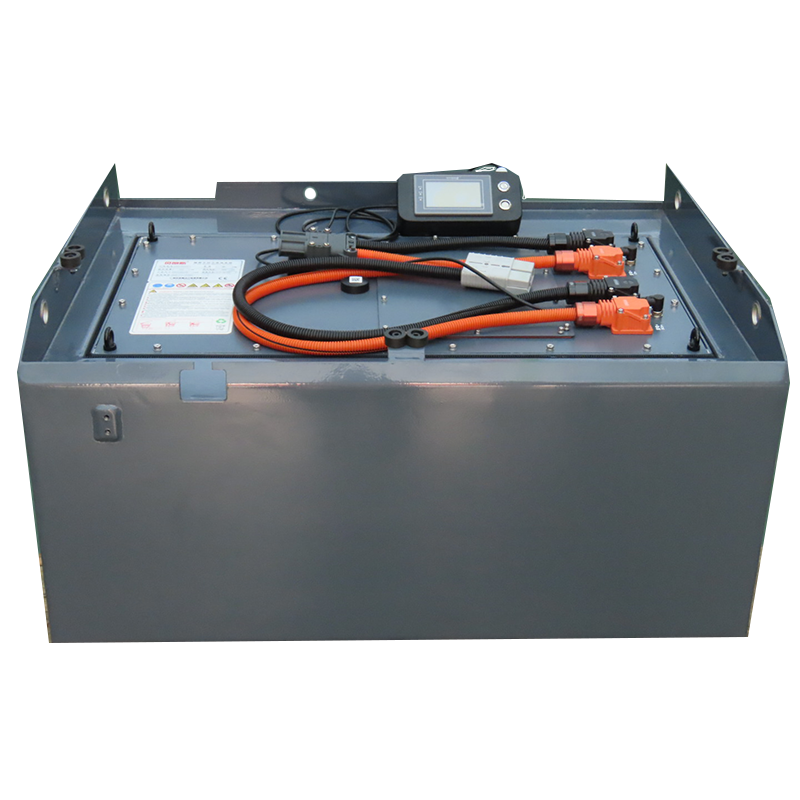
Comparison of key indicators between lithium-ion and lead-acid batteries for forklifts reveals the truth
Time:2025-07-15 13:47:14
Browse:266
In warehouse logistics and workshop production, forklifts serve as the core lifting equipment, and the performance of the battery directly affects operational efficiency, investment costs, and safety risks.
In warehouse logistics and workshop production, forklifts serve as the core lifting equipment, and the performance of the battery directly affects operational efficiency, investment costs, and safety risks. Currently, in the forklift battery market, lithium-ion and lead-acid batteries dominate the market. Many enterprises fall into the misconception that "lead-acid is cheaper and more cost-effective, so lithium-ion is unnecessary." However, disregarding the initial unit price, when comparing the three key indicators of range, charging time, and overall cost, the advantages of lithium-ion forklifts are clearly evident. They are not only the cost-effective choice for long-term operation but also completely outperform lead-acid batteries.
1. Core Indicator 1: Battery Life + Charging Efficiency. Lithium batteries break through operational bottlenecks, while lead-acid batteries slow down production pace.
For warehouses and workshops with multiple shifts and high operational loads, the insufficient battery range of forklifts and the long charging time are the biggest pain points that hinder production efficiency. These are also the core differences between lithium batteries and lead-acid batteries.
The shortcoming of the lead-acid battery in terms of endurance is quite obvious. When a conventional lead-acid forklift is fully charged, its continuous operation time is only 4-6 hours. If it is in a low-temperature environment, the endurance will shrink by more than 30%. This simply cannot meet the operational requirements of two shifts or three shifts. What's more troublesome is that the charging of lead-acid batteries not only takes 8-10 hours, but also requires an additional 6-8 hours of cooling after charging. During this period, the forklift cannot be used at all. Enterprises have to equip 2-3 sets of backup batteries for rotation, occupying a large amount of storage space and increasing the labor cost for battery transportation.
In contrast, lithium battery forklifts have completely solved this problem. Lithium batteries have a higher energy density, and when fully charged, they can operate continuously for 8 to 12 hours, covering the needs of a full-day single shift or even two shifts. There is no need to frequently change batteries. The charging efficiency is even more superior to that of lead-acid batteries. A regular lithium battery forklift can be fully charged in just 1-2 hours, and charging during the lunch break can meet the afternoon's operation needs. There is no need to arrange night shifts for charging, nor is a backup battery required, significantly improving the forklift's availability rate. More importantly, lithium batteries support on-demand charging. Partial charging does not damage the battery, completely breaking the limitation of lead-acid batteries that "must be fully discharged before being fully charged". They can flexibly adapt to various operation scenarios.
2. Core Indicator 2: Service Life. Lithium batteries are durable and convenient to use, while lead-acid batteries require frequent replacements which are not cost-effective.
The lifespan of batteries directly affects the long-term investment of enterprises. Many enterprises only notice the low initial price of lead-acid batteries, but overlook the hidden costs of their frequent replacements. However, the long lifespan advantage of lithium batteries can help enterprises avoid a lot of troubles.
The service life of lead-acid batteries is greatly influenced by the maintenance level and the frequency of charging and discharging. Even with meticulous maintenance, the normal service life is only 2-3 years. If maintenance is improper (such as forgetting to add water or charging irregularly), the lifespan will be shortened to around 1 year. Moreover, in the later stage of use, the battery's endurance will significantly decline. It often occurs that "the battery can only last for less than 2 hours after one charge", and replacement is inevitable. Frequent battery replacements not only consume time and effort but also increase the initial investment.
The service life of lithium battery for forklifts is much longer than that of lead-acid batteries. Under normal usage conditions, the lifespan can reach 5-8 years, which is 2-3 times that of lead-acid batteries. Lithium batteries adopt a sealed design and are equipped with an intelligent battery management system (BMS), which can automatically monitor voltage, temperature and charging/discharging status, avoiding damage to the battery caused by overcharging and overdischarging, and significantly reducing losses. Even after 5 years of use, the range of lithium batteries can still maintain more than 80% of the initial capacity, fully meeting the daily operation requirements, and there is no need for frequent replacement. This not only saves the labor and material costs of battery replacement but also reduces the downtime for forklift maintenance.
III. Core Indicator 3: Comprehensive Cost. The initial cost of lithium batteries is slightly higher, but it will result in significant profits in the long run.
To determine whether a battery is cost-effective, one should not only consider the initial unit price, but also calculate the long-term comprehensive cost (including initial purchase, maintenance, replacement, and energy consumption). From this perspective, lithium batteries have a much higher cost-performance ratio than lead-acid batteries.
The initial purchase price of lead-acid batteries is indeed lower than that of lithium batteries, but their maintenance costs and replacement costs are extremely high. Lead-acid batteries require regular water addition, acid liquid cleaning, and balanced charging. At least one or two professional maintenance sessions are needed per month, which not only requires dedicated personnel but also involves purchasing distilled water, anti-corrosion consumables, etc. The annual maintenance cost can reach several thousand yuan. Moreover, lead-acid batteries need to be replaced every 2-3 years, and the replacement cost for a set of lead-acid batteries can easily reach several thousand to tens of thousands of yuan. Over the long term, the cumulative investment is far higher than that of lithium batteries. In addition, lead-acid batteries have low charging efficiency and high energy consumption loss, and the annual electricity bill is also much higher than that of lithium batteries.
Although the initial purchase price of lithium battery forklift batteries is higher than that of lead-acid batteries, there is almost no maintenance cost in the later stage - no need to add water, no need to clean, and no need for dedicated maintenance. Annual maintenance costs can be saved by several thousand yuan. At the same time, lithium batteries have a long service life. They do not need to be replaced for 5 to 8 years, eliminating the cost of multiple battery replacements. In addition, lithium batteries have high charging efficiency and low energy consumption loss, with an energy conversion rate of over 95%. This saves 15-20% of electricity costs compared to lead-acid batteries. Over the long term, the overall cost of lithium batteries is more than 30% lower than that of lead-acid batteries. It can be recouped within 2-3 years, and an additional profit can be saved for the enterprise every year thereafter.
IV. Frequently Asked Questions: Eliminating All Your Concerns About Choosing Lithium Batteries
Question: The initial price of lithium battery for forklifts is higher than that of lead-acid batteries. Is it really a good choice for small and medium-sized enterprises to opt for lithium batteries? Answer: Absolutely it is. Most small and medium-sized enterprises pursue low-cost and efficient operations. Although lead-acid seems cheaper initially, frequent battery replacements, dedicated maintenance, and hidden costs such as energy consumption losses will bring continuous financial pressure to the enterprises. While lithium batteries may have a slightly higher initial investment, they have no maintenance costs, long lifespan, and low energy consumption. Within 2-3 years, the initial price difference can be recovered, and they can also save a lot of expenses each year, thereby reducing the financial burden on small and medium-sized enterprises, especially those with multiple shifts and high-load operations.
Question: Do lithium battery forklifts require special maintenance? Can they be used normally in low-temperature environments? Answer: Lithium battery forklifts do not need special maintenance. Daily maintenance only requires normal charging and avoiding violent collisions. This eliminates the cumbersome processes of adding water and cleaning like in lead-acid batteries, significantly reducing labor costs. In low-temperature environments, the performance of lithium batteries is also far superior to that of lead-acid batteries. Lead-acid batteries' range significantly decreases below 0℃, and they may even fail to start properly. However, lithium batteries can still maintain over 85% of their range at -20℃ and can start and operate normally, making them suitable for various low-temperature scenarios such as cold storage warehouses and outdoor areas in the north.
In conclusion, from the three core indicators of battery life, service life, and overall cost, lithium battery forklifts have a comprehensive advantage over lead-acid batteries. They not only improve operational efficiency and reduce long-term investment, but also can adapt to more complex working scenarios, eliminating the need for maintenance and replacement. Nowadays, with the maturity of lithium battery technology, the prices of lithium battery forklifts are gradually becoming more affordable. More and more enterprises are choosing to replace their forklifts with lithium batteries, making it a key to enhancing core competitiveness. For enterprises that pursue efficiency, low cost, and worry-free operation, lithium battery forklifts are undoubtedly the best choice. Choosing lithium batteries is choosing the guarantee for long-term profitability.